To know if we are truly implementing DevOps, ask release manager about their deployment bottlenecks.
Usually, we’ll hear the same story. The engineering team invested heavily in modern CI/CD tools. Developers are merging code daily with/without unit tests. The infrastructure and builds are automated. But instead of flowing seamlessly into production, release candidates pile up in a staging environment, waiting for a manual QA sign-off. DevOps promises velocity. But if our deployment pipeline operates like a bullet train that forces everyone to stop and pay at a manual tollbooth, you don’t actually have continuous delivery. You have continuous integration, waiting for feedback on Quality.
The Illusion of Speed
Enterprises often treat test automation as a separate track from development. QA teams write Selenium scripts in a silo, running them overnight or right before a release. By the time a bug is caught, the developer who wrote the code has moved on to other tickets.
When testing is an afterthought, the feedback loop stretches from minutes to days. The result? Velocity is impacted, to ensure quality, either we push regression to end of the sprint or skip testing to hit deadlines.
Embedding the Quality Feedback Loop
The only way to realize the ROI of DevOps is to embed test automation directly into the pipeline. Quality can’t be a phase at the end of the line; it must be a gate at every step.
- Shift Left at the PR: Tests shouldn’t wait for staging. Smoke tests and unit tests must run against every pull request. If the code breaks the build, it doesn’t merge. Period.
- Parallel Execution: A test suite that takes six hours to run is burden in a CI/CD environment. Break test suites into smaller, independent chunks and run them in parallel.
- Shared Ownership: Automation engineers shouldn’t be the only ones responsible for quality. When test results are embedded directly into developer workflows (like GitHub or GitLab comments), fixing broken tests becomes part of writing the feature, not a separate chore.
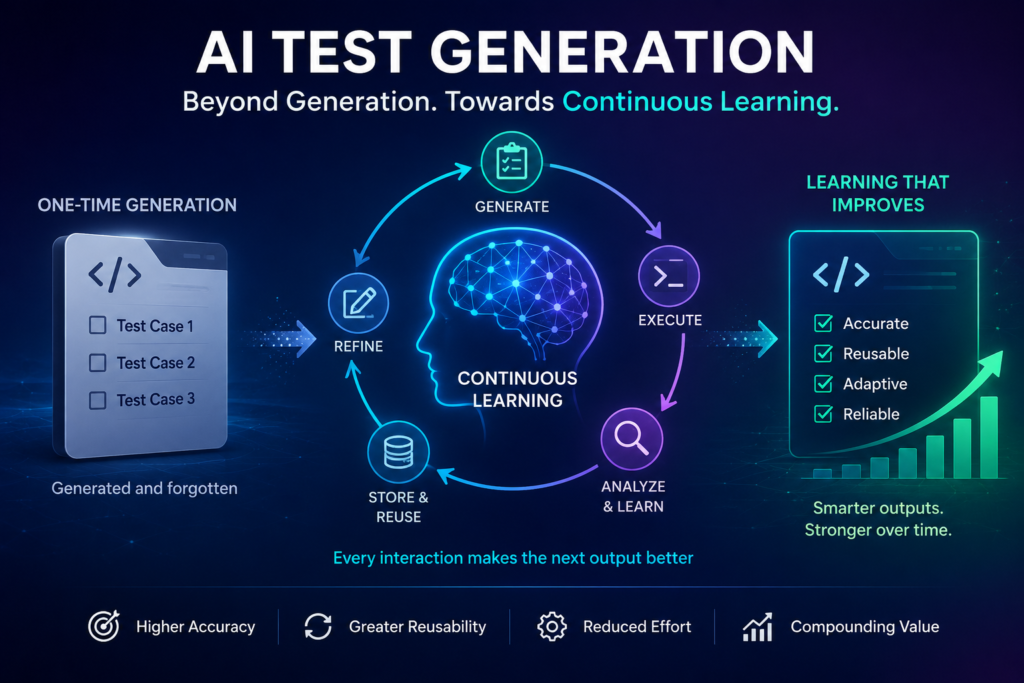
- Leverage AI: With AI, code is shipped faster, this is an opportunity for Testing teams to ship automation coverage faster. HIVEQ enables high-velocity scripting from Story to Test Cases to Test automation by integrating into your existing test automation framework and testing practices.
Moving Forward
Scaling an enterprise doesn’t mean you have to choose between moving fast and breaking things. It means building safety nets, equipping them with right tools that let testing team move fast with confidence. When test automation acts as the guardrails of your CI/CD pipeline rather than a roadblock at the end of it, you stop catching bugs and start preventing them.