Part of our AI in Testing series, our earlier blogs – Why AI Test Generation Fails to Scale: Solving the 40% Accuracy Plateau and Rethinking AI Test Generation:The Role of Continuous Learning, explored why many AI-powered testing systems deliver impressive initial results but struggle to maintain accuracy as they scale across larger, more complex applications. They also explored how the root cause often lies not in the AI model itself, but in the absence of a mechanism that enables the system to continuously learn from its own work and improve over time.
This naturally led us to the next question:
If AI needs to learn continuously, what does that actually look like in practice?
At HiveSprint, this question became the foundation for how we evolved HIVEQ. Rather than building another AI system that simply generates test artifacts, we wanted to build a system that becomes better every time it is used.
Rethinking Test Generation
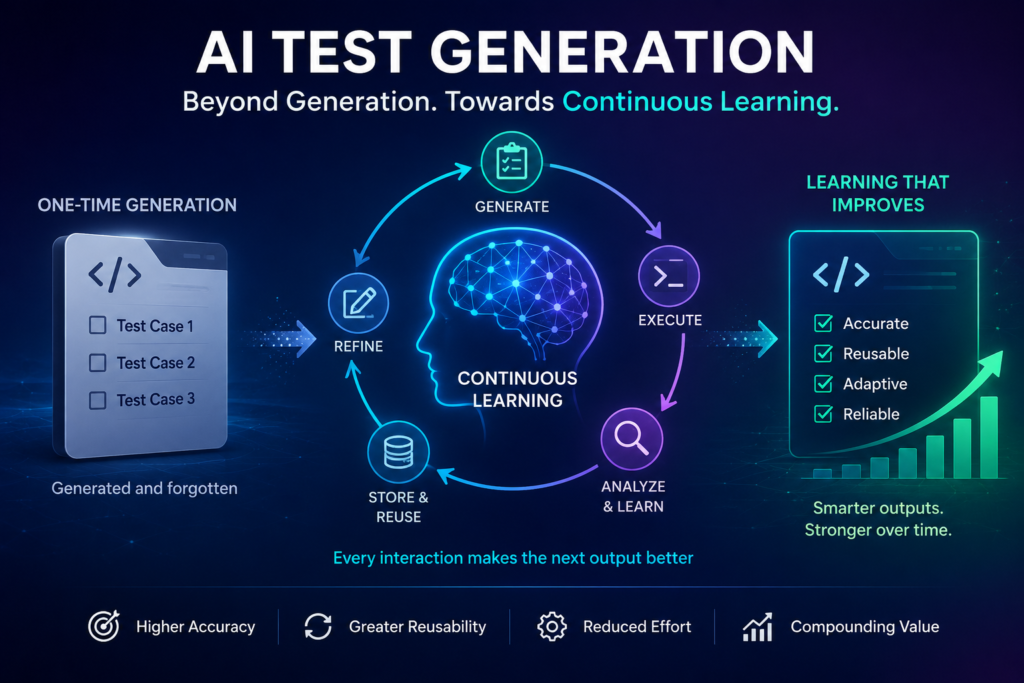
Traditional AI-based test generation typically follows a straightforward workflow. A requirement is provided, the AI analyzes it, generates test cases and automation scripts, and the interaction ends. When the next request arrives, the process begins almost from scratch, with very little knowledge carried forward from previous generations. While this approach delivers speed and immediate productivity gains, it offers little opportunity for the system to evolve. Each generated artifact remains largely isolated, with limited reuse of the intelligence created during earlier iterations. As a result, the system often ends up solving the same problems repeatedly instead of building upon what it has already learned.
Treating Every Output as Knowledge
We approached the problem differently.
Instead of viewing generated outputs as the end of the process, we treated them as the beginning of the next one. Every generated test case, manual test step, automation script, reusable method, correction, and refinement contains valuable information about the application and the automation framework.
Rather than discarding this information, HIVEQ captures it as structured knowledge that can be leveraged during future generations. This changes the role of generated artifacts. They are no longer simply outputs. They become part of the system’s growing intelligence.
A Learning Loop, Not Just Retrieval
Retrieval plays an important role in modern AI systems.
It enables the model to access existing knowledge instead of relying solely on its training data. For relatively stable information such as reusable framework methods, coding conventions, or project structure retrieval is highly effective.
However, software testing is inherently dynamic. Applications continuously evolve, user interfaces change, new automation utilities and framework components are introduced, and generated scripts are refined as teams gain a deeper understanding of the application. Failures and production issues often uncover better implementation patterns and more robust approaches. In such an environment, simply retrieving previously stored information is not enough.
The system also needs to decide what new knowledge should be retained, what existing knowledge should be updated, and how future generations should benefit from those improvements.
This is where continuous learning begins. Rather than relying on retrieval alone, HIVEQ continuously enriches its knowledge base with newly generated assets and refinements, enabling every iteration to contribute to future generations.
What Does the System Learn?
Over time, HIVEQ continuously builds knowledge across multiple dimensions.
- It learns reusable automation methods that can be shared across scenarios.
- It captures framework-specific implementation patterns so newly generated scripts remain consistent with the customer’s automation architecture.
- It remembers successful locator strategies and interaction patterns that have proven reliable during execution.
- When generated scripts are corrected or enhanced by testers, those refinements become part of the knowledge available to future generations.
- The system also accumulates understanding of application workflows and reusable validation approaches, allowing future outputs to become increasingly context-aware.
None of these improvements happen through a single generation. They emerge through repeated usage and continuous refinement.
Building a System That Evolves
Our objective was never simply to generate automation faster, it was to build a system whose capabilities grow with every project, every test case, and every refinement. As HIVEQ is used, its knowledge base becomes progressively richer, enabling it to generate more consistent and context-aware outputs. Reuse increases naturally as previously generated assets are leveraged in future scenarios, while manual corrections gradually reduce because new learnings are continuously incorporated into subsequent generations. Rather than repeatedly solving the same problems, the system builds upon its previous work, becoming more effective and reliable over time.
Conclusion
The biggest shift was not introducing another AI model; It was changing how the system thinks about knowledge.
Instead of treating every generation as an isolated event, HIVEQ treats every generated asset as an opportunity to improve the next one. Continuous learning is therefore not a single feature or technology. It is an architectural principle that enables AI systems to evolve through usage.
What’s Next
So, did this architectural shift make a measurable difference?
In the final blog of this series, we’ll share the results of this experiment with HIVEQ including how a continuous learning approach improved automation accuracy from 40% to 70%, significantly increased reusability, and reinforced why the future of testing lies in combining Human expertise with continuously learning AI.