For a while, it seemed like AI had found a stable pattern. It answers when you ask something. It makes an answer when you give it a prompt. That interaction model, which is based on large language models, is the basis for most of the AI systems we use today. It has already changed the way we write, code, and talk to each other.
But a new thing is starting to happen.
AI systems are starting to do things instead of just answering. Not in a futuristic or fully autonomous way, but in a practical, down-to-earth way—doing tasks, using tools, and making progress toward a goal one step at a time. People are talking about AI agents when they talk about this change.
What is an AI agent?
An AI agent is basically a system that is made to reach a goal.
Instead of giving one answer, it figures out what needs to be done, breaks that work into steps, and tries to do each step. This might mean getting data from outside sources, making choices as you go, and changing things based on what happens.
At first, the difference may not seem like much, but it changes how these systems work. A traditional assistant’s job is to come up with an answer to a question. On the other hand, an agent is focused on reaching a goal. That often means doing more than one thing at a time, dealing with uncertainty, and working with systems that aren’t part of the model.
AI Agents vs Chatbots: What’s the Difference?
At a glance, AI agents and chatbots can look similar—they both interact with users and respond to inputs. But under the hood, they’re built for very different levels of capability.
Chatbots are primarily designed to respond.
They take an input (a question or prompt) and generate an output. Most chatbots follow predefined flows or rely on language models to generate replies. They’re great for:
- answering FAQs
- handling customer support queries
- simple conversational tasks
But their role usually ends there—they don’t take action beyond the conversation.
AI agents, on the other hand, are designed to act.
They don’t just respond—they can plan, decide, and execute tasks to achieve a goal. An AI agent can:
- break down a task into steps
- use tools or APIs
- remember context across interactions
- adjust its approach based on results
For example, a chatbot might help you draft an email.
An AI agent could write the email, find the recipient, send it, and track the response.
The simplest way to think about it:
Chatbots talk. AI agents do.
That shift—from responding to acting—is what makes AI agents fundamentally different, and far more powerful for real-world workflows.
From AI Assistants to AI Agents: What Changed?
Most of the AI tools people use today are still helpers. They are designed to be reactive, meaning they wait for input and then give output. Agents create a model that is more proactive. After being given a goal, they try to move forward on their own by breaking the problem down, figuring out what to do first, and then doing those things.
When you think about it, this seems simple, but in practice, it makes things more complicated in a different way. The system now has to keep track of decisions, dependencies, and outcomes over time because it changed from a single response to a series of actions. The opportunity and the challenge are both in that change from interaction to execution.
How AI Agents Work: The Agent Loop Explained
Most agent systems work in a loop that goes like this: they figure out a goal, make a plan of actions, carry out those actions, look at the results, and then repeat the process. This loop lets the system do things that can’t be done in one step.
This structure looks neat and logical on paper. In reality, each step could go wrong in some way. Plans may not be complete or may be too simple. Execution often relies on external tools that might not work as expected. It’s possible to misread observations, and small mistakes can add up as the system goes through its iterations. So, what looks like a neat loop in diagrams often doesn’t work as well in real life.
Tools in AI Agents: Capabilities and Limitations
The ability to use tools is what makes an agent more than just a reasoning system; it makes it able to do real work. Agents can get information, start actions, and work in real environments by connecting to APIs, databases, file systems, or other services.
This dependence on outside systems, on the other hand, makes things more fragile. APIs can stop working or give you data you didn’t expect. There may be latency problems with systems. Sources of data may not always be accurate or up to date. Adding more integrations makes things more powerful, but it also makes it easier for things to go wrong. An agent’s effectiveness is closely linked to how reliable the ecosystem around it is in many ways.
Multi-Agent Systems: When One Agent Isn’t Enough
When tasks get harder, one agent isn’t always enough. A lot of systems start to split up tasks among several agents, each of whom is in charge of a different part of the workflow. One person might focus on planning, another on getting information, another on carrying out the plan, and yet another on checking it.
This modular approach can make things easier to scale and understand, but it can also make it harder to coordinate. Agents need to talk to each other clearly and keep the same context. It’s harder to figure out what’s wrong when something goes wrong. The system is starting to look like distributed software architectures, which are powerful but harder to manage by nature.
AI Agent Architecture: The Part Most People Miss
A lot of the talk about AI agents is about their abilities, but the architecture that makes them work is just as important. How well an agent does over time depends a lot on how it handles memory, context management, state tracking, and error handling.
An agent’s behavior can change depending on how it stores and retrieves information. For example, if it loses track of earlier steps, it may not act consistently. In the same way, how it handles partial failures can mean the difference between a smooth recovery and a total breakdown. These details aren’t always clear in high-level talks, but they are very important for making agent systems work well.
Cost and Performance of AI Agents
The cost of running these systems is another important thing to think about. Agent workflows usually include making multiple model calls, going through the same reasoning steps over and over, and using tools from outside the system. This makes computing more expensive and, in many cases, makes responses take longer.
These things matter more as systems get bigger. What works in a controlled prototype can be costly and ineffective in production. Teams need to find a balance between capability and performance, especially when agents are expected to work all the time or on a large scale.
Are AI Agents Autonomous? Limits and Control
People often say that AI agents are independent, but that isn’t always true. In most real-world situations, these systems work within set limits. People often must give their approval before important actions can be taken, and there are rules in place to stop people from taking risks.
Monitoring and logging are also very important because they show how decisions are made and how actions are carried out. In practice, today’s agents are better understood as semi-autonomous systems that can work on their own but still need people to keep an eye on them to make sure they are safe and reliable.
Foundations of AI Agents: Earlier AI Concepts
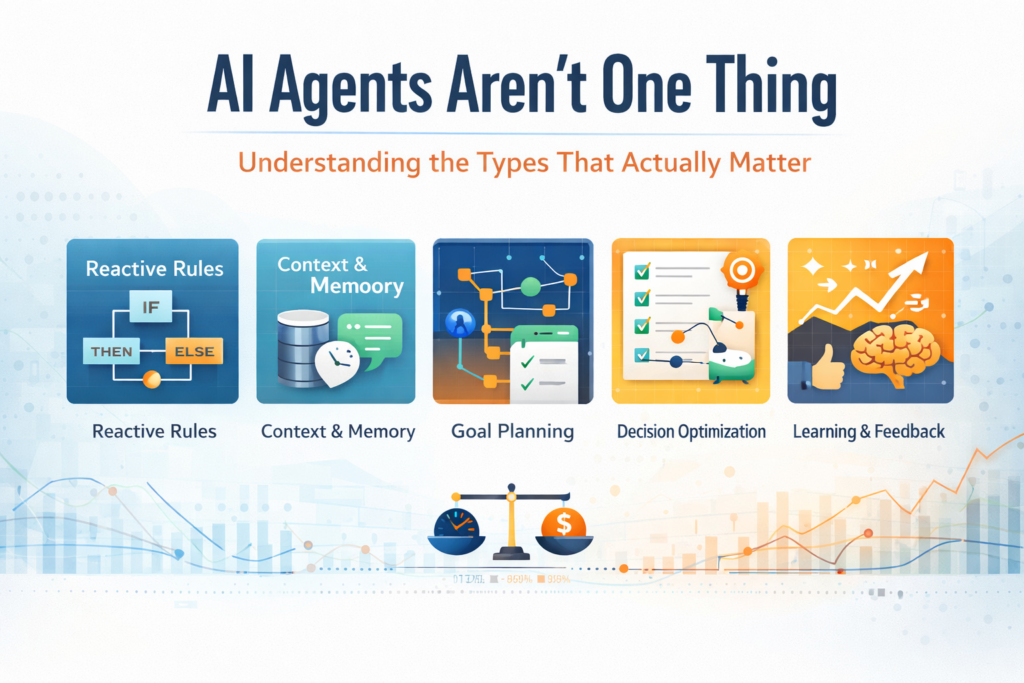
People are starting to pay more attention to AI agents, but the idea isn’t new. For a long time, traditional AI has looked into different kinds of agents, such as rule-based systems, goal-driven agents, and learning systems that get better over time.
The addition of large language models is what has changed. These models make things more flexible and can handle problems that aren’t structured. This combination lets you use older agent ideas in more useful and flexible ways.
The Current State of AI Agents
AI agents are a big step forward in how we think about smart systems. They change the focus from making outputs to working toward outcomes, which allows for more complex and dynamic use cases.
At the same time, there is still a big difference between the idea of agents and how they work in the real world. People are still working on problems with reliability, cost, coordination, and system design.
Conclusion: Why AI Agents Matter Now
There is real progress here, and we should pay attention to it. AI agents make it possible for systems to plan, act, and change in ways that are different from how AI usually works.
The truth is more complicated than the story usually makes it out to be. The worth of these systems will depend on more than just what they can do; it will also depend on how well and safely they can do it in the real world.
And that part is still changing.