Introduction
AI test generation is rapidly reshaping how organizations approach software quality. While what once required deep expertise and significant manual effort is now being accelerated, many teams are finding that simply generating test cases and automation scripts is not enough to sustain long-term success.
At HIVESPRINT, we approached this transformation with a focus on the customer’s existing ecosystem. HIVEQ is not a standalone tool; it is an AI-driven solution that produces test cases, test steps, and scripts directly within existing open-source frameworks like Selenium and Playwright. By aligning our technology with these frameworks, we ensure seamless integration without creating vendor dependency.
The Illusion of Early Success
At first glance, the benefits of AI test generation appear undeniable:
- Faster test design cycles that reduce time-to-market.
- Reduced manual effort for repetitive scripting tasks.
- Increased automation coverage across complex application modules.
Most solutions perform exceptionally well in controlled environments and demos. They simulate user flows effectively and produce outputs that appear immediately usable. This creates a strong initial perception that the technology is working perfectly. However, as organizations move toward real-world adoption across evolving applications and dynamic UI changes, the effectiveness of the generated assets begins to plateau.
The Real Problem: Why AI Testing ROI Stagnates
In our hands-on experimentation using HIVEQ, we observed a consistent pattern regarding the reliability of automated outputs. Initially, results are encouraging and build team confidence. However, as usage expands across complex workflows, a different reality emerges:
- Inconsistent Outputs: The logic from a generated test today may differ from what is produced tomorrow for the same flow.
- Stagnant AI Automation Accuracy: As complexity increases, the system struggles to maintain precision and reliable AI automation accuracy.
- Manual Corrections: Automation scripts often require significant human intervention to become production-ready.
- Limited Reusability: Assets created through these engines are often treated as “disposable” rather than long-term assets.
When measured, the results were clear: Our benchmark for AI automation accuracy showed a consistent plateau at ~40%. This means more than half of the scripts were not production-ready without manual fixes. While the technology was accelerating the initial drafting process, AI test generation was not yet delivering a reliable, scalable outcome for the enterprise.
The Root Cause: Lack of Continuous Learning
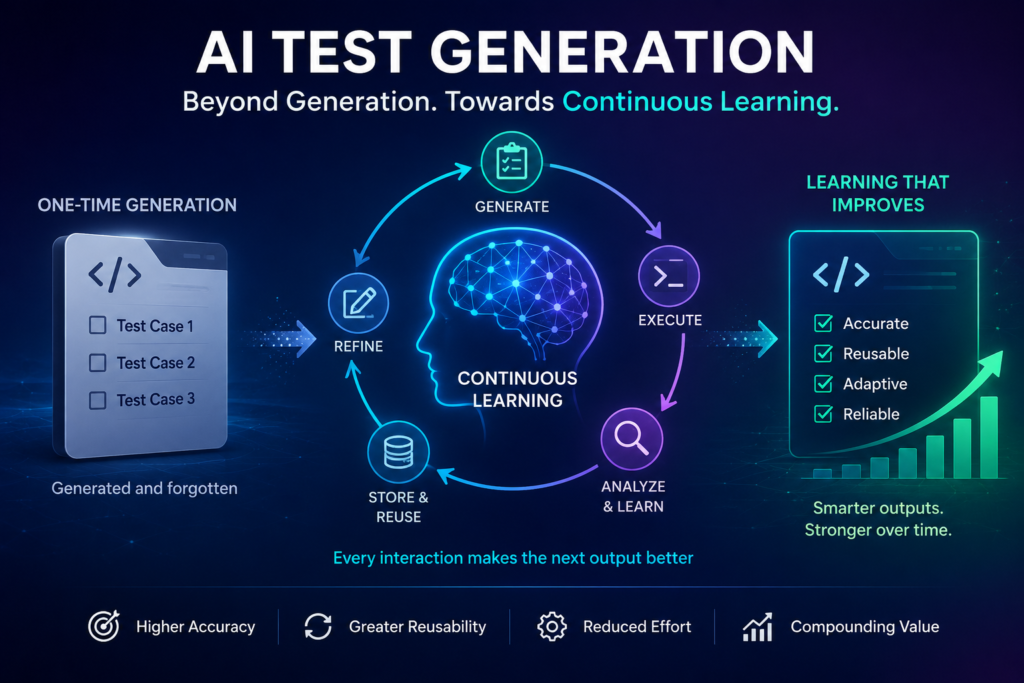
The fundamental issue is that most engines function in isolation. Each request for AI test generation is treated as a one-time event with minimal carry-forward learning. While this enables speed, it lacks the continuity required for complex testing.
There is often no “memory” of past outputs, no learning from previous manual corrections, and no mechanism to capture and reuse previously generated assets to improve future Playwright or Selenium scripts. Essentially, the system restarts from zero every time a new request is made, which negatively impacts the overall AI testing ROI.
In contrast, a human tester evolves. Every time a tester works on an application, they build context, recognize patterns, and improve their AI automation accuracy over time. For AI test generation to deliver on its promise, it must mirror this compounding effect.
Conclusion
Acceleration alone is not enough to maintain a high AI testing ROI. To deliver real, scalable value, systems must move beyond simple AI test generation and move toward systems that evolve through learning. The true opportunity lies in building intelligence that improves with every interaction – capturing knowledge, adapting to UI changes, and delivering compounding value over the entire software development lifecycle.
What’s Next
In the next blog, we will explore the mechanics of continuous learning and how it bridges the gap between early promise and sustained impact in the testing landscape.